
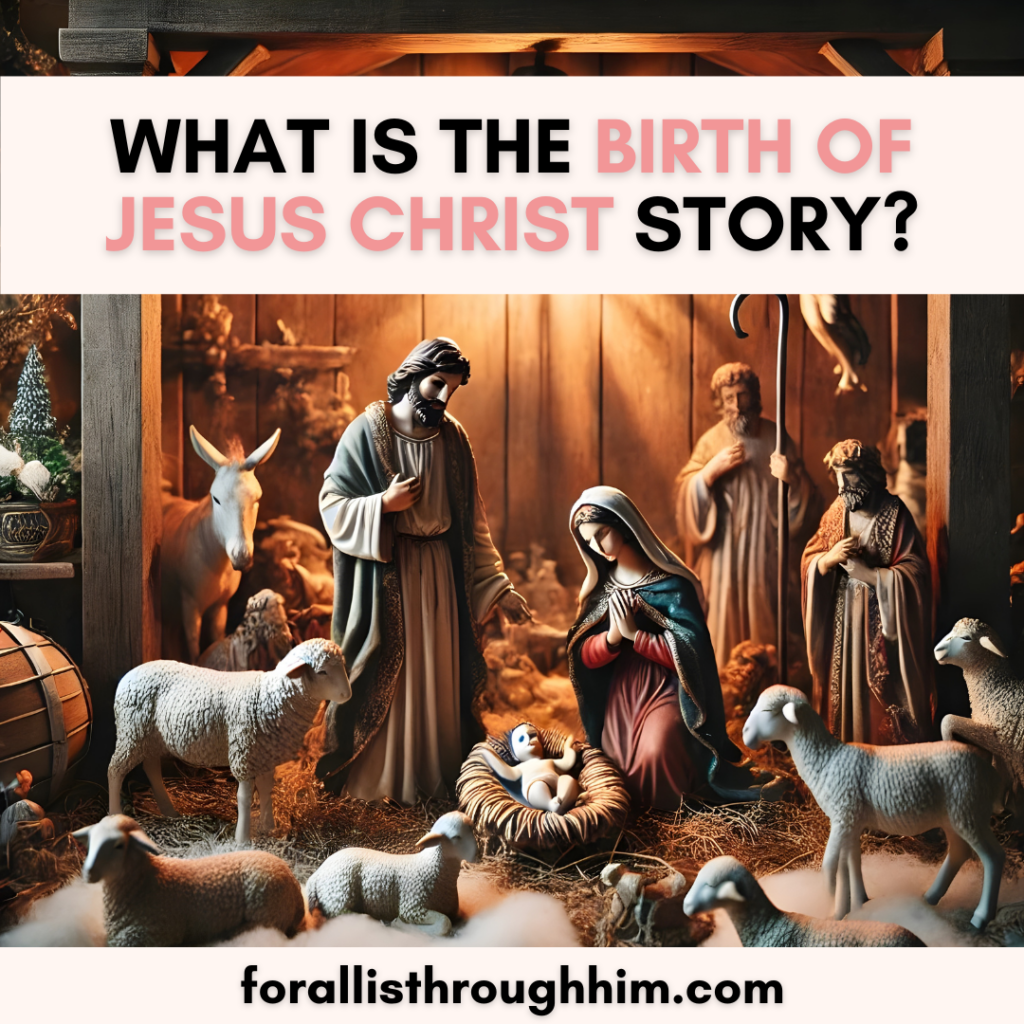
The birth of Jesus Christ’s story is one of the most beautiful and powerful passages in the entire Bible. It’s a story many of us have heard since childhood, yet every time we read it, we discover new layers of God’s love, promise, and purpose.
Found in Matthew 1–2 and Luke 1–2, the nativity story isn’t just a Christmas tradition; it marks the moment when God stepped into human history to bring salvation to the world.
In this post, we’ll walk through the story as the Bible tells it, using Scripture, historical context, and spiritual meaning to help you understand it more deeply.
Let’s go!
What is the Birth of Jesus Christ Story? (Overview)
The story begins with a young virgin woman named Mary, a carpenter named Joseph, and God’s plan unfolding in the most unexpected way.
Before Jesus was born, God had already promised through prophets like Isaiah and Micah that a Saviour, the Messiah, would come into the world. The birth of Jesus fulfils those exact prophecies.
The Bible tells us that:
- An angel announces Jesus’ birth to Mary.
- Joseph receives divine confirmation in a dream.
- Mary and Joseph travel to Bethlehem due to a Roman census.
- Jesus is born in humble conditions and laid in a manger.
- Shepherds and wise men come to worship Him.
- The event marks the arrival of Immanuel, “God with us.”
Now let’s walk through the story step by step.
The Angel Gabriel’s Announcement to Mary
One of the most beautiful moments in Scripture is when the angel Gabriel appears to Mary in Luke 1:26–38.
He tells her:
“You will conceive and give birth to a son, and you are to call Him Jesus.”
Mary is shocked; she’s a virgin, yet Gabriel explains that the Holy Spirit will come upon her and the child will be the Son of God.
But Gabriel doesn’t stop there. He goes on to describe who Jesus truly is:
- He will be great
- He will be called the Son of the Most High
- The Lord will give Him the throne of His father David
- He will reign over Jacob’s descendants forever
- His kingdom will never end
These words reveal so much about the identity and significance of Jesus.
1. Jesus’ birth was miraculous and divine.
This wasn’t a humanly orchestrated pregnancy. It was the work of the Holy Spirit, showing us that Jesus is fully divine, God in the flesh.
2. His throne being eternal hints at His deity.
In Scripture, an everlasting kingdom is something only God can possess. For Jesus’ throne to last forever means His rule is eternal, something no ordinary human king could achieve.
3. Reigning over Jacob’s descendants points to kingship and authority.
To reign over Israel is to hold the highest spiritual and royal authority. This type of reign is associated only with God Himself, showing us once again that Jesus is not just a prophet or teacher, He is God.
4. The throne of David connects Jesus to Old Testament prophecy.
Gabriel’s words directly echo prophecies from the Old Testament, promises that a descendant of David would rise as the Messiah and rule forever (such as in 2 Samuel 7:12–16 and Isaiah 9:6–7). This connection between Jesus and the “throne of David” is a powerful reminder that God was fulfilling promises He made centuries before.
And all of this is spoken to a humble, unknown village girl named Mary, reminding us again that God loves to use the ordinary to bring forth the extraordinary.
And Mary’s response?
“Let it be to me according to your word.”
What an incredible example of faith.
Joseph’s Dream
Naturally, Joseph is confused when he learns Mary is pregnant. At this point, Mary and Joseph were not yet married; they were betrothed, which in Jewish culture was a legally binding engagement. Breaking off a betrothal required a formal divorce, and being found pregnant during this period was considered a serious offence.
Culturally and historically, a woman becoming pregnant before marriage could face public shame, social rejection, and even harsh punishment. From Joseph’s perspective, it looked like betrayal. The kindest and most honourable option he saw was to quietly end the engagement so Mary wouldn’t be humiliated.
But God steps in.
In Matthew 1:18–25, an angel appears to Joseph in a dream and addresses him as “Joseph, son of David.” This is significant. Joseph was a descendant of King David, and this detail connects directly to the Old Testament prophecies we mentioned earlier, that the Messiah would come from the line of David and that the throne of David would be established forever.
By addressing Joseph this way, the angel is highlighting that Jesus’ earthly legal father comes from the royal lineage of David. This means Jesus, by birthright, is tied to the prophetic royal line, another confirmation that He is the promised Messiah.
Then the angel tells him:
“Do not be afraid to take Mary as your wife because what is conceived in her is from the Holy Spirit.”
The angel also explains that the child within her will “save His people from their sins,” and he tells Joseph to give the child the name Jesus.
The name Jesus is the Greek form of the Hebrew name Joshua, which means “the Lord saves.” Even His name reveals His mission, Jesus came to bring salvation to God’s people.
Matthew then adds that this miraculous conception fulfils the prophecy of Isaiah 7:14:
“The virgin will conceive and give birth to a son, and they will call him Immanuel,” (which means “God with us.”)
This divine reassurance changes everything for Joseph. He chooses obedience, takes Mary as his wife, and protects both her and the unborn Messiah. His response shows incredible character, faith, compassion, and trust in God’s plan, even when the situation didn’t make sense.
Why was Jesus born in Bethlehem?
Even though Mary and Joseph lived in Nazareth, the prophet Micah had already declared hundreds of years earlier that the Messiah would be born in Bethlehem.
How does God make that happen? Through a Roman census ordered by Caesar Augustus.
A Roman census was a government registration used to count the population for taxation and military purposes. Everyone was required to return to their ancestral hometown to be registered. For Joseph, who was from the lineage of David, this meant travelling to Bethlehem, the City of David.
So Mary, heavily pregnant, travels with Joseph to Bethlehem. This wasn’t a comfortable journey, but it was a divine setup to fulfil prophecy.
And this is where Micah 5:2 comes to life:
“But you, Bethlehem Ephrathah… out of you will come for me one who will be ruler over Israel…”
This prophecy is extraordinary. Micah specifically named Bethlehem, a small, unlikely town, as the birthplace of the Messiah. Yet Micah had no way of knowing that centuries later, a Roman census would force the exact circumstances needed for Jesus to be born there.
It’s a powerful reminder that God’s plan for salvation was in motion long before Mary and Joseph existed. His promises never fail. His Word never returns void. And every detail of Jesus’ birth shows that God had the redemption of the world on His heart from the very beginning.
Jesus is Born and Laid in a Manger
When they arrive in Bethlehem, there is no room available for them, so Mary gives birth in what many believe was a stable or even a cave. Luke 2:7 explains this clearly:
“She gave birth to her firstborn son; and she wrapped Him in cloths, and laid Him in a manger, because there was no room for them in the inn.”
A manger is simply a feeding trough for animals, yet this is where the Saviour of the world was placed.
This moment carries powerful symbolism. The King of kings did not come with a royal ceremony. Instead, He entered the world in humility. Philippians 2:6–7 reminds us that although Jesus was in very nature God, He made Himself nothing, taking on the form of a servant and being born in human likeness.
“Though He was in the form of God, He did not consider equality with God something to be used to His own advantage; instead, He emptied Himself by taking the form of a servant and being made in human likeness.”
His birth wasn’t announced in palaces or to royalty; it happened quietly, in a setting most people would overlook. From the very beginning of His life, Jesus demonstrated humility, showing us that God’s glory often appears in the most unexpected places.
The Shepherds and Angels Rejoice
While Jesus lay in the manger, shepherds were watching their flocks nearby. Suddenly, an angel appeared and announced the birth of the Saviour, saying that He was Christ the Lord. Then a whole host of angels filled the sky, praising God and saying in Luke 2:14:
“Glory to God in the highest, and on earth peace to those on whom his favor rests.”
The shepherds rushed to Bethlehem, found Jesus, and began spreading the news (Luke 2:15-18).
It is significant that shepherds were the first to hear about Jesus. In the cultural and historical context of the time, shepherds were considered low-status workers, often living on the margins of society. They were not respected or highly regarded and were frequently overlooked in both social and religious circles. Yet God chose them to be the first witnesses of the Messiah’s birth. This demonstrates that the gospel is for everyone, not just the wealthy, powerful, or influential.
There is also a beautiful connection to God as our Shepherd, Jehovah Rohi. Just as God guides, protects, and cares for His people, He intentionally directs the shepherds to the newborn King.
This moment also echoes the life of David, Israel’s greatest king, who was a shepherd boy before he was anointed. David was overlooked by his family and society, yet God chose him to lead Israel. Similarly, Jesus was born in humble circumstances, lying in a manger, seemingly overlooked by the world, yet He is the true King and Messiah. The shepherds’ low status in society mirrors the humility of Jesus’ birth and highlights how God’s plan often works through the ordinary and unexpected to fulfil His extraordinary purposes.
The Wise Men and the Star of Bethlehem
In Matthew 2:1–12, we read about wise men, or Magi, from the east who saw a special star signalling the birth of the King of the Jews. They travelled a great distance, guided by the star, to honour Jesus with gifts of gold, frankincense, and myrrh.
The visit of the wise men is significant for several reasons. First, these men were likely astrologers, scholars, or religious leaders in their own lands. They were not Jewish, yet God revealed the Messiah to them, showing that His plan of salvation extends beyond Israel to all nations. This fulfils the idea that Jesus came for everyone, not just one group of people.
Second, their gifts carry deep meaning: gold for kingship, frankincense for deity and priesthood, and myrrh foreshadowing His suffering and death. Even in their gifts, the wise men recognised Jesus’ dual nature as both God and King and His ultimate mission to save humanity.
Third, their journey fulfils Old Testament prophecies. The Messiah was predicted to be a light to the nations (Isaiah 49:6), and the Magi’s journey demonstrates that people from faraway lands would recognise and honour Him. It also highlights that God orchestrates circumstances, even guiding foreigners, to acknowledge His plan.
Finally, the contrast between the shepherds and the wise men is striking. Shepherds, lowly and overlooked, were the first to hear and spread the news, while the wise men, educated and influential, sought Him out from afar. Both groups, despite vastly different social statuses, recognised and worshipped the same Messiah. This shows that God’s plan is inclusive and sovereign, working in ways that surpass human expectations.
Even King Herod, representing worldly power and human authority, was unaware of God’s plan and attempted to oppose it. Yet God protected Jesus and ensured that His mission would proceed according to prophecy, reinforcing that His salvation plan cannot be thwarted by human schemes.
The Prophecies and Purpose of Jesus’ Birth
From the Old Testament to the New Testament, the Bible contains numerous prophecies pointing to the coming of the Messiah. These prophecies were not random predictions; they show God’s meticulous plan for salvation and Jesus’ divine identity. The details of His birth, life, and mission were foretold hundreds of years in advance. Here are some key prophecies and what they mean:
“Therefore the Lord himself will give you a sign: The virgin will conceive and give birth to a son, and will call him Immanuel.”
- The Messiah is a human being who has no earthly father and is God.
- The verse clearly refers to a ‘son’.
- He is to be called ‘Immanuel’, which means ‘God with us’.
- The Hebrew word almah may mean “young woman” or “virgin,” but in context, it was always understood as a virgin.
- The Septuagint (Greek translation of the Old Testament) translated almah as parthenos, which exclusively means “virgin.”
- Fulfilled in Matthew 1:23 and Luke 1:34–35.
“For to us a child is born, to us a son is given, and the government will be on his shoulders. And he will be called Wonderful Counselor, Mighty God, Everlasting Father, Prince of Peace. Of the greatness of his government and peace there will be no end. Of the greatness of his government and peace there will be no end. He will reign on David’s throne and over his kingdom, establishing and upholding it with justice and righteousness from that time on and forever. The zeal of the LORD Almighty will accomplish this.”
- The child will rule with divine authority and establish an eternal kingdom.
- The titles: Wonderful Counsellor, Mighty God, Everlasting Father, Prince of Peace, emphasise His deity and eternal kingship.
- He will establish an everlasting government.
- His rule brings justice, righteousness, and peace for all nations.
“The scepter will not depart from Judah, nor the ruler’s staff from between his feet, until he to whom it belongs shall come and the obedience of the nations shall be his.”
- The Messiah would come from the tribe of Judah.
- The “scepter” symbolises kingship and authority.
- Points to Jesus’ royal lineage and ultimate dominion over Israel and the nations.
“Your house and your kingdom will endure forever before me; your throne will be established forever.”
- God promises David an eternal kingdom.
- Jesus, through His earthly lineage from David (via Joseph), fulfils this promise.
- His kingdom will never end, pointing to His divine authority and eternal kingship.
“But you, Bethlehem Ephrathah, though you are small among the clans of Judah, out of you will come for me one who will be ruler over Israel.”
- Bethlehem, a small town, would be the Messiah’s birthplace.
- The prophecy is extraordinary because it names the exact town centuries before Jesus’ birth.
- Fulfilled when Joseph and Mary travelled to Bethlehem due to the Roman census (Matthew 2:1–6).
“He was pierced for our transgressions, he was crushed for our iniquities; the punishment that brought us peace was on him, and by his wounds we are healed.”
- Describes the suffering servant who bears the sins of many.
- Points to Jesus’ crucifixion and atoning sacrifice.
- Shows that the Messiah’s mission was to save humanity, not to establish an earthly political kingdom.
“Listen, High Priest Joshua, you and your associates seated before you, who are men symbolic of things to come: I am going to bring my servant, the Branch. See, the stone I have set in front of Joshua! There are seven eyes on that one stone, and I will engrave an inscription on it,” says the Lord Almighty.
- The Messiah is called “the Branch,” symbolising a new beginning and God’s chosen servant.
- The name Jesus is the Greek form of the Hebrew name Joshua, which means “the Lord saves.”
- He would purify and restore God’s people.
- Points to Jesus’ role as the fulfilment of God’s covenant and plan of salvation.
“When Israel was a child, I loved him, and out of Egypt I called my son.”
- Fulfilled when Joseph and Mary brought Jesus to Egypt to escape King Herod (Matthew 2:14-15).
- Demonstrates God’s protection and faithfulness.
- Connects Jesus to Israel’s history, showing that God’s plan of salvation flows through His people.
These prophecies show that Jesus’ birth was not ordinary or random. Every detail, from His lineage and birthplace to His divine nature and mission, was planned by God. He came to be King, Saviour, and God with us, fulfilling hundreds of years of prophecy and establishing His eternal kingdom.
What the Birth of Jesus Means for Christians Today
The birth of Jesus Christ is far more than a beautiful story or a festive tradition; it is the foundation of the Christian faith. Every detail of His birth, from the angelic announcement to Mary and Joseph, to the humble manger in Bethlehem, to the fulfilment of centuries-old prophecies, points to one central truth: Jesus is the Messiah, God with us, and the Saviour of the world.
For Christians, the true meaning of Christmas is not about gifts, decorations, or holiday festivities. It is about celebrating the arrival of Jesus, the one who came to bring salvation, hope, and peace. He is truly the reason for the season.
Jesus’ birth reminds us that God’s plan for salvation was intentional and perfect. From being born in humble circumstances to being recognised by both the lowly shepherds and wise men from distant lands, His life shows us that God works through ordinary people and unexpected situations to accomplish extraordinary purposes. The prophecies fulfilled in His birth, life, and ministry demonstrate that God is faithful, sovereign, and deeply involved in the world.
As we reflect on the nativity story, we see that Jesus’ coming is a reminder of:
- God keeps His promises.
- His love for all people, regardless of status or background.
- The humility and obedience required to walk in God’s plan.
- The hope and salvation that He offers to everyone who believes.
So this Christmas, we are invited to go beyond the traditions and focus on the true reason we celebrate: Jesus Christ, the Saviour, the King, and God with us. His birth is a call to remember that God’s love entered the world in the most tangible way possible, and that His gift of salvation is available to all.
Related: 6 Meaningful Ways to Celebrate Christmas as a Christian
FAQs
Was Jesus born on Christmas Day, the 25th of December?
The short answer is we don’t know for sure. However, the reason many Christians celebrate His birthday on the 25th of December is:
- The date of December 25 was first recorded as a celebration of Christ’s birth in a Roman calendar from AD 336.
- The choice appears to have been influenced by a tradition (among some early Christians) linking the conception or “incarnation” of Jesus to March 25, then counting nine months to arrive at December 25.
- Over time, December 25 became established as the formal date for the feast of Christmas in much of Western Christendom.
Related: The Truth Behind Christmas – Is Christmas a Pagan Holiday?
I hope this blog post helped to give you an understanding of the story of the birth of Jesus and its significance.
Let us celebrate with joy, gratitude, and awe for the miracle of the Saviour’s birth, and let every heart reflect on the eternal truth that Jesus is the Messiah, born to bring hope, peace, and everlasting life.
Share this blog post with someone to inform them of the reason why we celebrate Christmas – Jesus Christ!
Stay blessed,
Divine L.

Hi, I am Divine L., your sister-in-F.A.I.T.H., who is passionate about discipling Christian girls to be a walking embodiment of Jesus Christ in their daily lives and to help young girls and woman become who God destined for them to become. It is a great blessing to welcome you to the F.A.I.T.H. sisterhood!